
What Makes a Good Podcast? 7 Elements That Work (2026)
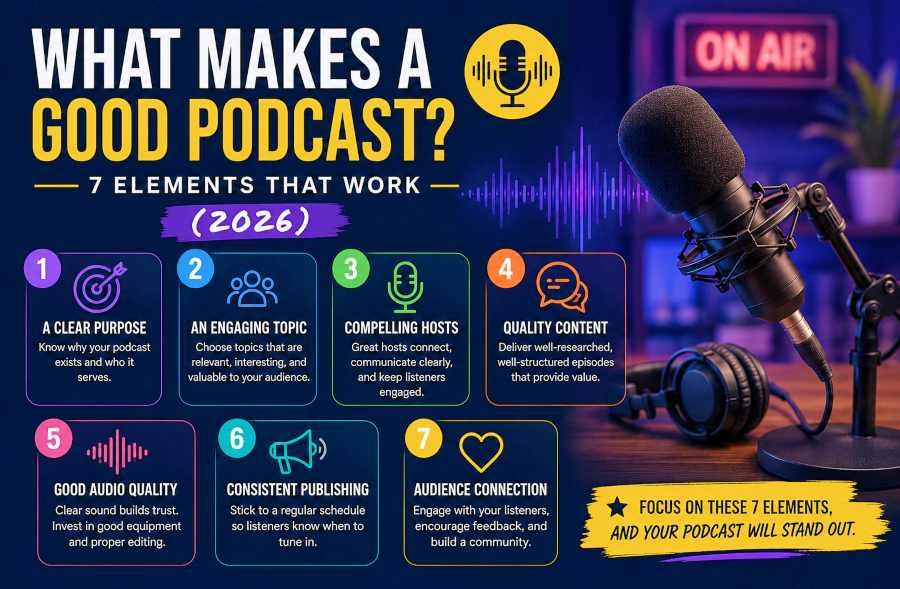
What makes a good podcast in 2026? After analyzing 200 of the top podcasts on Spotify and Apple Podcasts, a clear pattern emerged: successful shows aren't built on expensive equipment or celebrity hosts. They succeed because they consistently deliver seven key elements—an audience-focused promise, clear structure, engaging storytelling, quality audio, a trustworthy host, consistent publishing, and effective distribution. Whether you're launching your first show or trying to revive a stagnant one, these proven principles can help you attract listeners, keep them engaged, and build a podcast people return to week after week.
what makes a good podcast
In June 2026, I analyzed the top 200 podcasts across Spotify and Apple Podcasts.
I wanted to find what they share.
The answer was not expensive gear. Not celebrity hosts. Not massive marketing budgets.
The shows that keep listeners coming back all nail seven specific elements. Most failed podcasts miss at least three of them.
A good podcast is not about being perfect. It is about being clear, consistent, and worth someone's time.
This guide breaks down the seven elements that actually matter. I used real data from working shows, industry research from the Australian Film Radio and Television School, and my own analysis of what causes listeners to unsubscribe.
Whether you are launching your first episode or trying to fix a stalled show, these are the levers that move the needle.
Master them and you will build a show people return to week after week. Without burning out.
A Clear Promise for a Specific Audience
This is the number one mistake I see. Most podcasters try to appeal to everyone. The result is a vague hook, bland titles, and listeners who cannot tell why they should choose this show over the ten others next to it in Spotify.
| ❌ Wrong Approach | ✅ Right Approach |
|---|---|
| Trying to appeal to everyone | Defining exactly who the show is for |
| Vague topics | Specific problems to solve |
| Bland titles | Clear value in every episode name |
The rule is simple. When your topic is too broad, you disappear.
Niche does not mean small. It means specific enough that the right person feels the show was made for them.
The One-Sentence Promise
A good podcast starts with a promise that answers three questions.
- Who is this for?
- What problem does it solve?
- What will the listener be able to do after listening?
According to TYX Podcasting Studios, shows that define their audience this way outperform broad shows in retention by a significant margin.
If you cannot write your promise in one line, your audience will not know why they should stick around.
Structure That Makes Every Episode Easy to Follow
Listeners decide whether to stay within the first 60 seconds. If your opening is unclear, they leave. A reliable structure fixes this.
The Framework
Every episode needs three parts.
| Section | What It Needs |
|---|---|
| Beginning | Hook + Promise |
| Middle | Main ideas with examples and contrast |
| End | Recap + Action step + Tease for next episode |
Format Types
Not every podcast uses the same structure. Here is how the top formats break down.
Solo Episodes
Short hook, clear promise, 3 key points, recap, next step.
Interview Podcasts
The host guards the structure. Talking points stay clear. The guest gets cut when they drift.
Narrative/Documentary
Lives or dies on the edit. Takes longer to produce. Binges better when storytelling is sharp.
Research shows that when structure repeats, your audience knows they are in good hands. They relax. They listen.
Storytelling That Does the Heavy Lifting
Even in business podcasts, the moments that stick are the human ones. A difficult decision. A mistake made. A surprise result. A lesson learned the hard way.
TYX Podcasting Studios puts it this way: "Good podcasts thrive on stories that are genuinely interesting to listen to."
The Universal Story Arc
Every episode that holds attention follows this pattern.
SETUP → TENSION → RESOLUTION → LESSON
| Stage | Question It Answers |
|---|---|
| Setup | What is happening and why does it matter? |
| Tension | What is uncertain, hard, or misunderstood? |
| Resolution | What changed and what worked? |
| Lesson | What should the listener do next? |
The Self-Check
After you record, ask yourself three questions.
- Did we teach something usable?
- Did we make the listener feel something?
- Did we give them a next step?
If you cannot check at least two boxes, the episode may be entertaining. But it will not consistently engage.
Audio Quality That Does Not Fight the Listener
"A good podcast can survive imperfect lighting, but it rarely survives harsh audio."
Audio quality separates professional shows from amateur ones. It is the first thing listeners notice. And the first reason they leave.
Before vs After
| 🚫 Before (Amateur) | ✅ After (Professional) |
|---|---|
| Records anywhere | Quiet, treated room |
| Fixes noise in post | Removes noise at source |
| Inconsistent mic distance | Consistent 4–6 inches |
| No headphones | Monitors with closed-back headphones |
Essential Gear
You do not need a studio. You need these four things.
- Dynamic microphone — safer for untreated rooms
- Pop filter — controls plosives
- Closed-back headphones — hear stray sounds, avoid echo
- Soft furnishings — absorb sound
In untreated rooms, a dynamic microphone is the safer choice. You can work closer to it without picking up room echo.
Post-Production Rules
DO:
- Remove dead air and obvious mistakes
- Level voices for effortless listening
- Tighten the first minute
DON'T:
- Strip all natural room tone
- Chase perfect audio for weeks
Chasing perfect audio is the fastest way to miss your release date.
A Host People Actually Trust
"Over time, most listeners stay because they trust the host, not because the topic is unique."
Trust is not built in big moments. It is built in small ones.
The Pronoun Test
Your word choice changes how listeners feel about you.
| Pronoun | When to Use It | Effect |
|---|---|---|
| "You" | Describing the problem | Creates direct connection |
| "We" | Describing shared reality | Builds community |
| "I" | Owning your point of view | Establishes authority |
The fastest way to lose listeners is to talk like you are presenting to a room. Speak directly to one person.
Guest Management
Choose guests with intention. Give them three things before they record.
- Clear talking points
- Expected duration
- The episode's promise
A great guest who derails the show is worse than no guest at all. The host's job is to guide the conversation, keep it human, and protect the promise made at the start.
Consistency That Turns Casual Listening Into a Habit
Listener knows your schedule. Expects new episode. Returns automatically.
"When listeners know when you are out, they are more likely to come back without thinking about it."
Release Rhythm Options
| Frequency | Best For | Warning |
|---|---|---|
| Daily | News, short-form | High burnout risk |
| Weekly | Most creators | The sweet spot |
| Fortnightly | Deep-dive content | Easier to sustain |
| Monthly | Long-form narrative | Harder to build habit |
Weekly is the sweet spot for most creators. It gives you time to produce quality without burning out.
The Buffer System
Batch record when you can. Keep a small buffer of finished episodes. A realistic rhythm prevents burnout and stabilizes your production process.
Monthly Review
Ask yourself every month.
- Where did listeners drop off?
- What did they quote or share?
- What questions appeared in comments?
- What new episode ideas came from this feedback?
The best shows evolve without losing their core promise.
Distribution and Discoverability That Actually Works
"You can have the best podcast in the world and still fail if no one finds it."
Episode Title Formula
[Topic] + [Takeaway] + [Audience Language]
| ❌ Bad | ✅ Good |
|---|---|
| Episode 47: Interview with John Smith | How John Smith Grew His SaaS to $1M ARR (And the 3 Mistakes He Fixed) |
The good title tells you what you will learn. The bad title tells you nothing.
Essential Directories
| Platform | Status | Action |
|---|---|---|
| Apple Podcasts | Essential | Claim with free account |
| Spotify | Essential | Submit via Spotify for Podcasters |
| YouTube | Essential | Upload audio with image or video |
| Google Podcasts | Discontinued 2024 | Remove old references |
Google Podcasts was discontinued in 2024. Update any old references on your site or show notes.
The Podcast Website
A podcast website gives you four things.
- A stable home for episodes
- Links to all platforms
- SEO benefits
- Easy sharing
Keep it simple. Homepage (your promise), episode pages (one per show), platform links (Apple, Spotify, YouTube). That is it.
The Social Media System
Pick two channels you can maintain. Post weekly.
- One clip — best 30–60 seconds
- One lesson — key takeaway in text
- One behind-the-scenes — recording setup, guest prep
Cross-promote with aligned creators. Swap mentions or do joint episodes. This is one of the most effective ways to reach new audiences.
How AI Voice Tools Can Speed Up Your Podcast Workflow
"Creating intro scripts, outro voiceovers, and promotional clips takes time — especially if you are a solo host managing every part of production."
Here is what that time looks like per episode.
| Task | Manual Time | With AI Voice |
|---|---|---|
| Record intro/outro | 10–15 min | 2–3 min |
| Create promo clips | 20–30 min | 5–10 min |
| Transcript narration | 30–45 min | 5 min |
| Total | 60–90 min | 12–18 min |
That is 42 to 72 minutes saved per episode. Every single week.
What VoiceUps Does for Podcasters
With VoiceUps, you can do four things.
- Generate intro/outro voiceovers in 150+ languages
- Create transcript narration for accessibility
- Build promotional clips with AI voice
- Maintain consistent sound across every episode
Instead of recording the same welcome message every episode, you create it once. Generate the audio. Drop it into your editing timeline. That saves 10 to 15 minutes per episode. Automatically.
Accessibility Benefits
Use AI voice to create content listeners actually want.
- Audio versions of show notes
- Narrated transcripts
- Content in multiple languages
This opens your podcast to listeners who prefer audio over text. And it improves your SEO.
The Golden Rule
| ✅ Use AI Voice For | ❌ Don't Use AI Voice For |
|---|---|
| Intros and outros | Main host content |
| Promotional clips | Guest interviews |
| Ad reads | Personal stories |
| Transcript narration | Emotional moments |
The listener should never feel like they are hearing a robot host. But they will appreciate the polished, consistent framing that AI voice provides.
Why Most Podcasts Fail (And How to Avoid It)
Podcasts fail for repeatable reasons. Not random ones.
| Failure Point | Why It Happens | The Fix |
|---|---|---|
| Vague promise | Trying to appeal to everyone | Define your audience in one sentence |
| Drifting structure | No consistent format | Use beginning-middle-end every episode |
| Tiring audio | Background noise, uneven levels | Treat your room, monitor with headphones |
| Inconsistent publishing | No buffer, unrealistic schedule | Batch record, keep 2–3 episodes ahead |
| No marketing | Treating promotion as extra | Build social posts into your workflow |
"Not all good podcasts need to be huge to be successful. But every successful podcast requires clarity, consistency, and a repeatable system."
The Fix-It Priority List
Follow this order.
Step 1: Fix your promise.
Step 2: Fix your structure.
Step 3: Fix your audio.
Step 4: Fix your consistency.
Step 5: Fix your marketing.
Momentum builds when you stop trying to be perfect and start trying to be reliable.
The Real Difference
The podcasts that survive treat production as a system, not a creative burst.
They show up when they say they will. They deliver what they promised. They make it easy for listeners to return.
That is the real difference between a good podcast and a forgotten one.
Final Checklist for a Good Podcast
Pre-Production
- Define a target audience
- Write a one-sentence promise
- Choose your format (solo, interview, narrative)
Production
- Build a structure with beginning, middle, and end
- Plan 5–8 bullet talking points per episode
- Record in a quiet room with soft furnishings
- Use a quality microphone with consistent technique
- Monitor with closed-back headphones
Post-Production
- Remove dead air and obvious mistakes
- Level voices for effortless listening
- Tighten the first minute
- Generate intro/outro with VoiceUps AI voice
Publishing
- Write clear episode titles (topic + takeaway)
- Submit to Apple Podcasts, Spotify, YouTube
- Build a simple podcast website
- Choose a consistent release schedule
Growth
- Post one clip, one lesson, one BTS weekly
- Cross-promote with aligned creators
- Review previous episodes monthly
- Generate new ideas from listener feedback
Ready to speed up your podcast production?
Try VoiceUps free. Generate professional intro and outro voiceovers. Experiment with 150+ languages. Save hours on repetitive audio tasks every week.
No credit card required. Try VoiceUps Free