Best TTS Models
ElevenLabs isn't the only name anymore. Gemini, Cartesia, Inworld, OpenAI, and open-weights models each win on different metrics. Here's how to pick — and when to skip the API entirely with Voiceup.
 600+ Voices
No API keys
600+ Voices
No API keys
Compare models in the studio — paste script, pick voice, ship MP3
Why model choice matters
Text-to-speech stopped being a single-vendor game. Real-time agents demand sub-200ms latency. Audiobook publishers want emotional range across 80,000 words. Enterprise teams need 140-language coverage with SLA guarantees. Open-weights models now run on a laptop GPU.
Choosing the wrong model wastes money and ships bad UX. A quality-first model in a voice bot feels laggy. A latency-first model in a YouTube narration sounds flat. This guide maps models to constraints — not hype cycles.
Wrong pick vs right pick
Complete guide
Before comparing ELO scores, name the one metric that breaks your product if you miss it. Voice agents bind on latency — users abandon calls after 400ms of silence. Audiobook publishers bind on expressiveness and chapter consistency. Privacy-sensitive teams bind on data residency. Streamers bind on pronunciation clarity for donation usernames.
Most teams have a primary constraint and a secondary nice-to-have. Write both down. A model that wins latency but fails your acronym list is still the wrong model.
Independent benchmarks like Artificial Analysis Speech Arena rank models on blind listening quality. Latency tables from Cartesia and Gradium publish P50 TTFA numbers. Cross-reference both against your use case category, then generate audio from your actual copy — not generic benchmark sentences.
Product names, medical terms, and gaming usernames expose weaknesses that leaderboard averages hide. Run the same 500-word script through two or three finalists. Blind-listen with teammates. Measure TTFA from your server region if latency matters.
Developers building voice agents integrate Cartesia, Deepgram, or OpenAI TTS directly — full control, per-character billing, DevOps overhead. Teams with GPU budget self-host Kokoro 82M or Fish Audio S2 Pro to cut API costs at scale. Creators, marketers, and indie authors typically choose a studio like Voiceup: paste script, pick voice, download MP3 — no API keys, no model YAML, no cold-start tuning.
Voiceup abstracts the neural backend so you ship audio today while model rankings shift weekly. When a new model tops the leaderboard, hosted studios can route to it without you rewriting integration code.
Latency leaders (Cartesia, Gradium), quality leaders (Gemini Flash, Inworld), narration kings (ElevenLabs v3), and open-weights options (Kokoro, Fish Audio) — mapped to the constraint that actually matters for your workflow.
Cartesia Sonic ~82ms, Gradium ~155ms P50 — built for conversational AI.
Gemini 3.1 Flash and Inworld Realtime top blind listening tests.
ElevenLabs v3 — multi-speaker, emotional range, creator default.
Kokoro 82M on CPU; Fish Audio S2 Pro for multilingual self-host.
Skip API integration — paste, pick voice, export MP3 instantly.
| Approach | Setup time | Cost model | Best for |
|---|---|---|---|
| Voiceup studio | Minutes | 5,000 chars free on signup | Creators, marketers, indie authors |
| Direct API (ElevenLabs, Cartesia, OpenAI) | Days–weeks | Per-character / per-minute | Engineering teams, custom agents |
| Self-hosted open weights | Weeks + GPU ops | Infra only at scale | Privacy, high-volume internal tools |
| Legacy cloud TTS (Polly, Azure standard) | Hours | Per-million chars | Enterprise compliance, broad langs |
| Human narrator | Weeks–months | $200–400/hr finished | Flagship commercial audiobooks |
By the numbers
Voice agents need latency. Audiobooks need expressiveness. Streamers need clarity. Enterprise needs languages. One model rarely wins all four.
~82ms
Fastest TTFA tier
70+
Top multilingual
1
Studio for all — Voiceup
Why this fits
Cartesia Sonic 3.5 (~82ms), Gradium (~155ms P50), Deepgram Aura-2 — built for conversational AI agents.
Gemini 3.1 Flash TTS and Inworld Realtime top blind listening tests for naturalness.
ElevenLabs v3 — multi-speaker, emotional range, industry standard for creative production.
Kokoro 82M (CPU-friendly), Fish Audio S2 Pro (multilingual) — self-host to cut API bills.
Azure HD (140+ langs), ElevenLabs v3 (70+), Fish Audio (80+) — coverage vs consistency tradeoff.
Skip model YAML. Paste script, pick voice, ship MP3 — we handle the neural backend.
Workflow
The exact steps creators in this space follow with Voiceup — copy them on day one.
Agent latency? Audiobook warmth? Stream meme clarity? Enterprise languages?
Cross-reference latency benchmarks, WER data, and blind quality ELO for your use case.
Benchmarks use generic sentences. Your product names and acronyms are the real test.
Or integrate an API if you need raw model control. Most creators choose the faster path.
Voice picks
Suggestions based on what teams in this space actually pick — start here, then explore the full library.
Real-time tier
Voice agents & IVR
Creative tier
YouTube & audiobooks
Voiceup studio
No API required
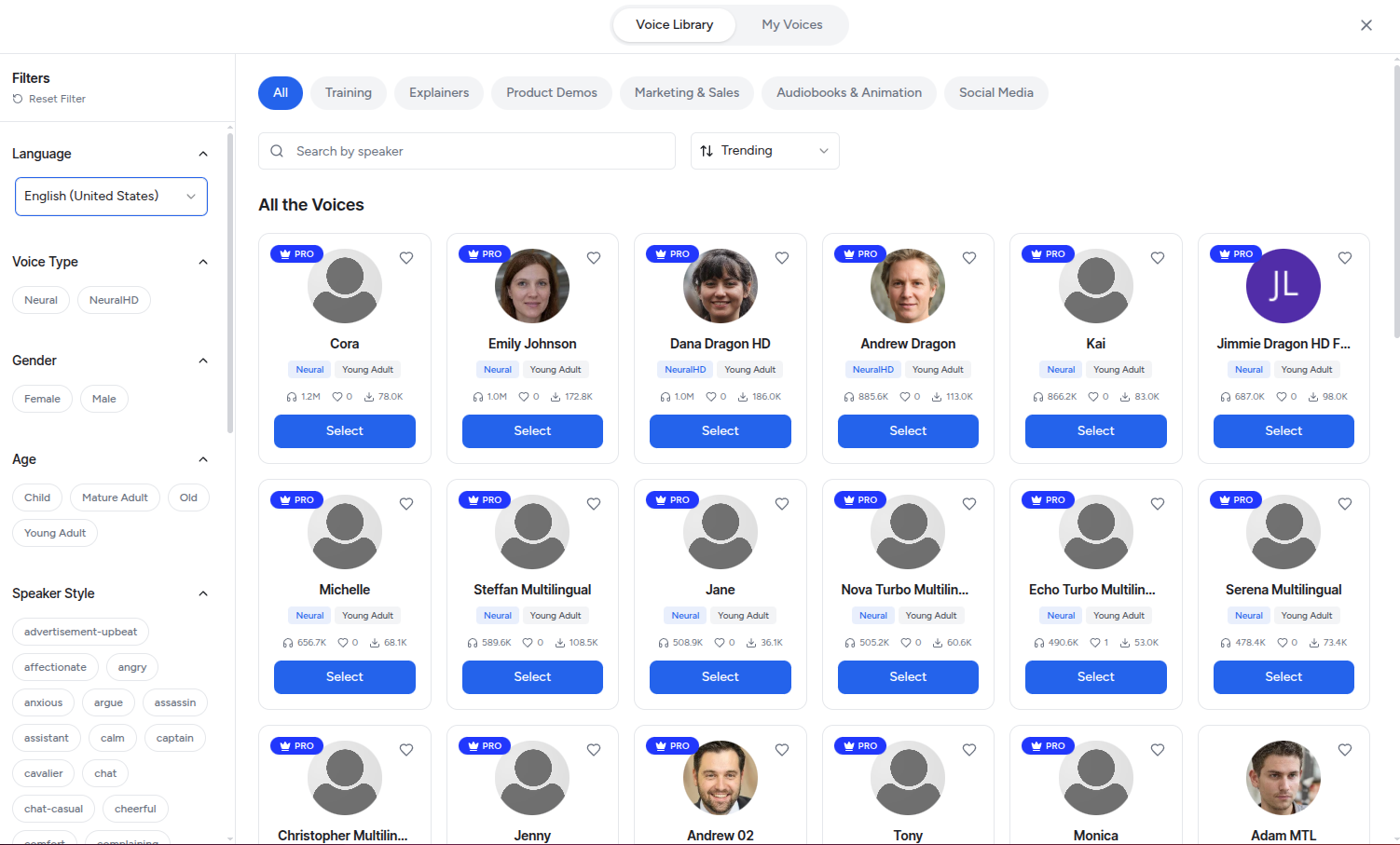
Browse the full voice library inside the studio. Open Voiceup
In the wild
Sub-200ms TTFA keeps conversations natural — Cartesia and Gradium lead here.
Expressive models win on YouTube; Voiceup bundles quality without per-character billing.
Kokoro on CPU for internal tools; Fish Audio when GPU budget allows.
Gemini and Azure when you need 70–140 languages from one vendor.
Independent benchmarks as of early 2026. Rankings shift — always test with your script.
| Model / Platform | Best for | TTFA (approx.) | Languages | Notes |
|---|---|---|---|---|
| Cartesia Sonic 3.5 | Real-time agents | ~82–188ms | 40+ | SSM architecture; top latency tier |
| Gradium TTS | Low-latency agents | ~155ms P50 | 30+ | Consistent sub-200ms in EU/US regions |
| Gemini 3.1 Flash TTS | Blind quality #1 | Moderate | 70+ | Leads Speech Arena ELO snapshots |
| Inworld Realtime | Expressive agents | ~200ms | 20+ | Strong emotion + game NPC workflows |
| ElevenLabs v3 | Creative narration | 300ms+ | 70+ | Expressive; industry default for creators |
| ElevenLabs Turbo v2.5 | Fast multilingual | ~264ms | 32+ | Balanced speed + 28ms IQR consistency |
| Deepgram Aura-2 | Voice agents | ~180ms | 10+ | Streaming-first; strong English clarity |
| OpenAI TTS-1-HD | Developer API | ~2s+ | Limited | High quality but slow for live agents |
| Azure Speech HD | Enterprise i18n | Moderate | 140+ | Broadest language coverage; SLA options |
| PlayHT 2.0 Turbo | Creator narration | ~250ms | 40+ | Voice cloning + instant voice library |
| Kokoro 82M | Self-hosted / free | Local GPU/CPU | 8+ | Apache 2.0; runs on modest hardware |
| Fish Audio S2 Pro | Open multilingual | Self-hosted | 80+ | Strong open tier; commercial license paid |
| Murf Falcon | Marketing video | Moderate | 20+ | Studio UI + stock music integration |
| Voiceup | Creators & teams | Instant preview | 150+ | 600+ voices, 1,000+ accents — studio UI, MP3 export |
Cartesia Sonic, Gradium, Deepgram Aura-2
Latency is the binding constraint. Users hang up after 400ms of silence.
Voiceup, ElevenLabs v3, Gemini Flash
Naturalness and expressiveness beat milliseconds.
ElevenLabs v3, Voiceup studio
Consistent chapter voice and SSML pacing control.
Voiceup + Streamer.bot
Pre-generated MP3 beats live API latency for donation reads.
Kokoro 82M, Fish Audio S2 Pro
No data leaves your infrastructure.
Azure Speech HD, Gemini
140+ and 70+ language coverage respectively.
Inworld Realtime, ElevenLabs v3
Emotional range and low-latency variants for interactive characters.
Voiceup, Azure Speech
Fast batch generation with consistent corporate narrator voice.
FAQ
Try the workflow
Open the studio, paste your script, and listen. The fastest test is your own ears.
No credit card required · Cancel anytime


Keizersgracht, Amsterdam, Netherlands
Voiceup is subscription-based AI text-to-speech software for creators, educators, and teams. Convert text into natural narration using licensed synthetic voices for learning, productivity, and accessibility.
This platform does not provide voice cloning, impersonation, celebrity voice replication, deepfake audio, NSFW generation, or tools intended to infringe third-party rights.
Copyright 2020-2026. All Rights Reserved Voiceup